
Values
What’s the difference between being cheap versus being frugal?
I think it boils down to values. Frugal folks treat money as a means to an end, while cheap people value money for its own sake. Frugal people think carefully about what they value and spend consciously on those things while cutting costs on things they don’t value. Cheap people cut costs on everything, even on things they value. Money sits at the top of their value hierarchy, so it makes sense to do everything to save a penny. Conversely, money serves as a self-actualizing tool for frugal people. It allows them to live out their values. For example, they regularly donate to their favourite charities and give generous gifts to their family and close friends.
See Spencer Greenberg’s Valuism philosophy and his talk on intrinsic values for more on this topic. You can take his Intrinsic Values Test for free.
We all value different things. This explains why we don’t understand why someone spends thousands of dollars on their baseball card collection, or how someone can justify paying $350 a month for Pilates classes. Identifying our intrinsic values is essential to spending effectively. You benefit more from a dollar spent on something you value than the same dollar spent on something you don’t.
Optimization Problem
Of course, if one makes billions of dollars per year, it doesn’t matter how effectively they allocate their money. They’ll have enough left over to spend on the things they value, regardless. As you can see below, this is not the case for the vast majority of us. The median Canadian in my age bracket of 25-29 gets to spend $35,600 per year in 2021. That is not a lot of money considering you need to spend most of that on basic needs.
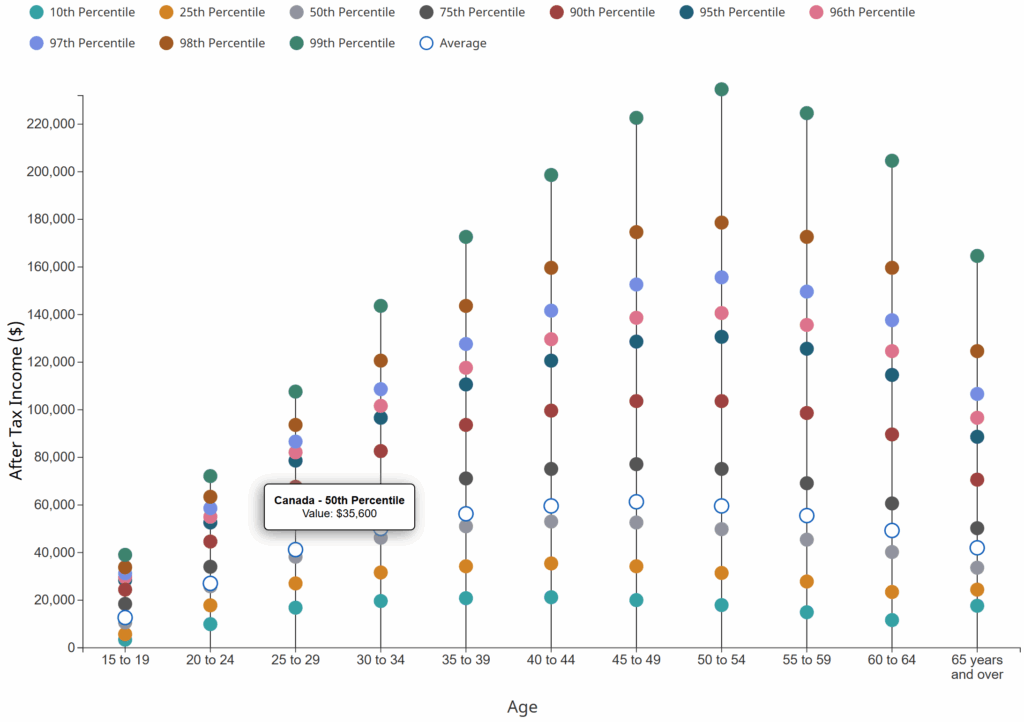
Consider the following monthly fixed expenses:
- Rent: $1000
- Utilities: $150
- Insurance: $100
- Phone plan: $50
- Groceries: $500
- Transportation: $300
- Personal care: $100
- Clothing: $100
- Social Activities: $200
- Subscription Services: $50
This strict budget still amounts to $2550 per month or $30,600 per year. This leaves the typical Canadian with $5000 to spend or save towards things they value. The budget above doesn’t include travelling, which many people value. This is why being frugal is rational and necessary. Most of us have a finite amount of money that we need to spend optimally to maximize the value we get from our labour. Frugal people attempt to solve this optimization problem. Cheap people minimize spending, while frugal people maximize utility.
Expenses tend to rise proportionally to income. People in their forties and fifties make more money, but that stage of life is typically associated with raising children, buying a home, paying for their kids’ tuition, helping them buy a home, travelling as a family, putting your kids through sports and hobbies, having a midlife crisis and buying an expensive car or launching a failing business. We need to earn a ton of money before we start to run out of ideas on how to spend it towards our values. The idea that money doesn’t make you happier once your basic needs are met has mostly been debunked. See the paper below.
- Experienced well-being rises with income, even above $75,000 per year
- If Money Doesn’t Make You Happy Then You Probably Aren’t Spending It Right
- Income and emotional well-being: A conflict resolved
- High income improves evaluation of life but not emotional well-being
I’ve tracked my mood multiple times per day for almost a decade with Daylio and How We Feel. My own experience and what the research bears out is that your moment-to-moment mood (affect) will stop improving after your basic needs are met. That said, your life satisfaction, well-being, and the story you tell yourself about yourself continue to improve as your income rises. This makes sense to me. I have many values that I would only get to actualize if I were in the 95th percentile or higher of income. Below are some things I’d like to do if I had tons of money:
- Donate significant sums to my favourite charities.
- Travel the world and pay for the trip for my close friends and family.
- Financially support my parents, brother, and my wife.
- Have a yearly scholarship in my name where I pay the tuition for a student in need.
- Not think about money. Make enough passive income from the yearly interest to live comfortably.
- Own a cottage where I host friends and family.
- Give a serious go at playing poker professionally.
- And the list goes on…
There are even more reasonable things, such as getting a sauna and an Eight Sleep Cooling mattress, that I can’t justify purchasing just yet. Dropping $4000 on a mattress when my current one is fine would limit how much I save towards a down payment and towards my travelling fund.
All the things above are virtually guaranteed to make my life better and the lives of those around me. Having more money is not evil. Money is a tool to live out your values. You can’t help your friends in need if you have nothing to give. You can’t host people. You can’t attend people’s weddings. Frugality is the tool to get to do these things on a tight budget.
The Spending Landscape
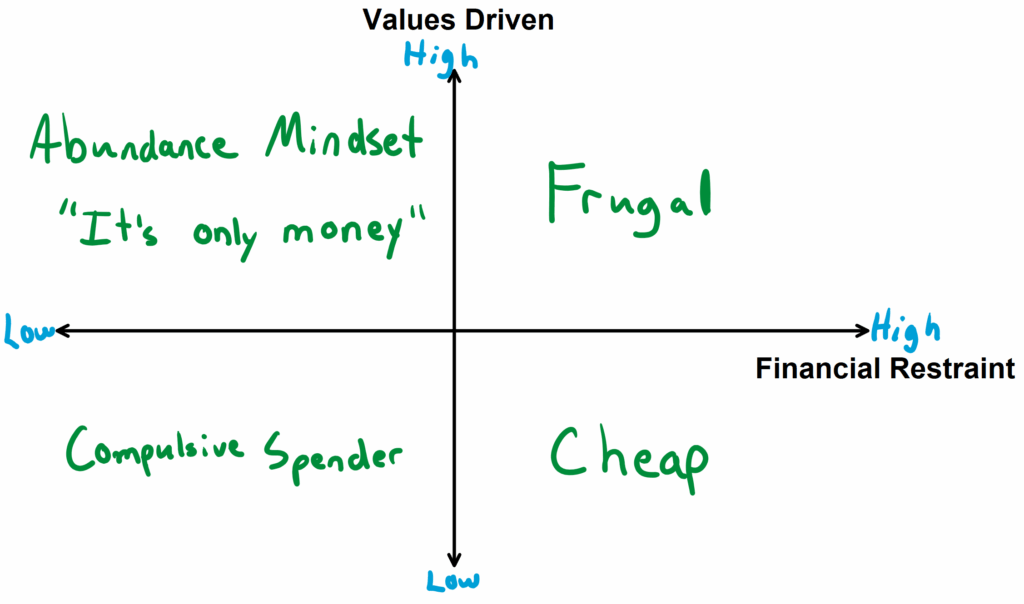
We often treat being cheap and frugal as two discrete categories, but they lie on a spectrum. Both frugal people and cheap people have high financial restraint, but they differ in where money falls in their value hierarchy. It’s also important to differentiate between being cheap as of necessity (broke college student) and being cheap with a high savings rate. It’s normal not to support local fundraisers as a student if it means that you’ll have to eat ramen noodles for the next week. It’s not prosocial to forgo supporting fundraisers when you have millions in the bank. It’s difficult to pinpoint the difference between cheap and fruga,l so I’ve listed some of my favourite examples below.
Frugal people balance delayed and instant gratification. They recognize both the magic of compounding and the reality that money loses value with age. Cheap people irrationally delay gratification and fail to draw down their assets in retirement.
Frugal people understand the law of diminishing returns. Cheap people always buy in bulk to save money, even if that means eating beans three times per day for two months.
Frugal people think systematically and big-picture about their finances. Cheap people obsess myopically over every cent. They’re penny-wise but pound-foolish.
Cheap people pounce on deals. Frugal people buy on their own terms, with patience, regardless of short-term price swings.
Frugal people align their spending with their values, often through automations, so their money serves their goals. They overspend unapologetically in categories they value, while ruthlessly cutting back in areas they don’t. Cheap people cut everywhere.
Frugal people save intentionally for things like a trip. They run the numbers with a realistic budget, accept the expense, and enjoy the experience without complaining every time money leaves their wallet.
Cheapness often spills into relationships. It inconveniences others, strains friendships, and disregards other people’s values.
Cheap people also disregard time: both their own and others’. They might lie, steal, or bend ethics to save money. They’ll overeat at free-food events just because it’s free, even if it undermines their health. They won’t support local charities.
Think about travel:
- Cheap is eating peanut butter sandwiches every day on a sidewalk in Paris, failing to recognize that part of the travelling experience in Paris is the food and restaurants.
- Frugal is packing your own food at a waterpark instead of being stuck with a mediocre $15 hot dog.
- Cheap is skipping Paris altogether, even when you’d like to go and you could afford it.
- Frugal is cutting corners elsewhere to save for the trip, and then fully enjoying it.
Cheap people don’t tip, no matter the service. They’ll steal dishware from restaurants or hoard freebies from fairs and conferences, regardless of usefulness or environmental impact.
Cheap people always talk about money. Frugal people talk about their values.
My Values
‘I haven’t taken action up to now, which means it can’t really be that important, which means it’s not a true value of mine, which means there’s no point in putting any effort into it.’ This reasoning is based on the false assumption that humans will naturally act in line with their values.
Russ Harris – The Hapiness Trap
Below is a list of my values that relate to finances. They’re in no specific order. Of course, some values are more important than others, but the relative importance of values shifts through time and depending on the context. We can examine and reevaluate our values by observing how we behave. I don’t think gambling addicts act out of their values, so behaviour is not always the best indicator of values.
- Minimalism
- Generosity
- Environmentalism
- Simplicity
- Truth
- Hosting
- Social interactions
- Community
- Meaning
- Play
- Curiosity
- Learning
- Creativity
- Gratitude
- Grit
- Authenticity
- Mastery
- Balance
- Autonomy
- Interdependece
- Net positive contribution
- Growth
- Happiness
- Humor
- Justice
- Kindness
- Compassion
- Fun
- Wisdom
Tell me what you value and I might believe you, but show me your calendar and your bank statement, and I’ll show you what you really value.
Peter Drucker
Rich Life
Values are too broad. I prefer to list specific things I invest my energy, time, and money in to live out my rich life.
- Pay extra to live in a central location to walk or bike to work.
- Buy books and pay for education without hesitation.
- Host people without thinking about money.
- Start working at 1 pm (or desired time) every day. Having flexibility in my schedule.
- Pay for fitness classes or equipment without hesitating.
- Not having to look at the price at the grocery store.
- Donate to charities and local organizations that mean something to me.
- Being able to volunteer without feeling like I should be getting paid.
- Continually taking university courses or getting coached.
- Having the financial confidence that I can say no to opportunities instead of saying yes for the money.
- Feeling good about outsourcing the things I don’t enjoy doing.
- Not worry about any decision that costs less than 100$ (change this number based on circumstances).
- Having the means to invest in or fund the projects and people I believe in.
- Not spending more than 30 minutes per month thinking about or managing money.
- Have an Oura ring.
- Have a sauna.
- Have a water-cooled mattress.
- Have a huge walk-in rock shower.
- Have an isolated cabin in nature for retreats.
- Play professional poker.
- Wake up naturally without an alarm.
- Be able to hang out with my friends and family.
- Have a yearly scholarship in my name.
- Pay for the no-ads version of subscription products.
- Pay for home-cooked, healthy, delicious meals a few times per week.
- Travel with the people I love around once per year, with other short excursions mixed in.
- Attend concerts and sporting events.
- Set up a family cabin that becomes a multi-generation meeting place.
Ways I’m Frugal
An interesting mathematical fact is that saving $5 does more to your savings rate than getting a $5 raise.
Consider the three fictitious scenarios below:
- Earn = $100, Spend = $100, Savings Rate = 0%.
- Earn = $100, Spend = $95, Savings Rate = 5%.
- Earn = $105, Spend = $100, Savings Rate = 5/105 = 4.76%.
Saving is more effective than getting a raise. That said, there are limits to how much you can save without significantly reducing your quality of life. On the contrary, increasing your income is practically limitless. Most people’s salaries increase naturally throughout their careers, as seen in the Statistics Canada data. It’s not like you have to focus only on either saving or increasing your income. You can do both simultaneously.
Below are some ways I cut expenses without sacrificing too much of my quality of life.
- We use a reusable dishcloth to save on napkins and limit environmental impact. You can throw the cloth in the dishwasher. I tear napkins in half and only use what I need.
- I have a bidet, which saves on toilet paper and leaves you with a cleaner butt.
- I do laundry and dishwasher at night to reduce cost, ease the grid, and help the environment.
- We hand dry our laundry. It’s better for clothing too.
- I turn off the lights when I’m not in the room, and we use LED bulbs. We don’t let the water run for no reason. I take long showers because it’s relaxing and I sometimes get good ideas in there.
- I use a credit card system and take part in many rewards programs.
- I try to do groceries on Tuesdays for student discounts. I shop the sales, but we still mostly buy the food we want.
- I grew up playing competitive hockey. I plan to pack snacks and staple foods for our kids so we’re never stranded. It’s faster, healthier, cheaper, and means we can afford more sports.
- I reuse scrap paper for notes. I try to minimize the paper printed for my students. I share the digital version of my lecture notes so they can draw on them with their tablets.
- I hate spending on mediocre products, food, or service. I love spending on a great meal I couldn’t make at home.
- Drinks at bars are deadly: overpriced, unhealthy, and not aligned with my priorities. I still dabble because of my social context, which is a worthwhile tradeoff. Friends and experiences are more important than the odd wallet and health hit.
- I bike to work and walk places. The health, wallet, and psychological benefits are huge.
- I pack my lunches for work.
- We rarely use Uber Eats, but order locally the odd time.
- I rarely shop online. I like to try on things, feel them in my hands, and do my research before buying something. I usually add items to my gift list in my second brain and then share this note with my wife and parents when they ask me what I want for Christmas and my birthday. Online shopping thrives on impulsivity. It also makes no sense to me how you can have a package at your door in 24 hours.
- My parents have a Costco membership. Costco is hard to beat for some products.
- $1.99 McDonald’s cone: it’s the experience that matters. This will be even more true when we have kids. But when I want quality, I get real sorbet or gelato.
- I get ~10% cashback at Starbucks. This is cheap motivation for a focused work session.
- Our apartment has a heat pump in our bedroom. This allows to cool only this small space. We open windows at night. to take advantage of nature’s rhythms. We tolerate a colder house in the winter and a warmer house in the summer. 18°C or 25°C is usually comfortable if you dress accordingly. We don’t shy away from adjusting when we’re uncomfortable. Again, balance and nuance are key ingredients of frugality done right.
- Solar panels and an EV are on my wishlist.
- I shop at Value Village for my physical books. We donate some of our possessions when we go through our stuff, which aligns with our minimalistic values.
- We use Facebook Marketplace for some items that maintain their value. I plan to use it for baby gear and one-off items like Halloween costumes. Never buy shoes that don’t fit.
- I’m looking forward to the day where artificial intelligence will be able to efficiently match people in their local communities. For example, I could tell my AI assistant that I lost my pitching wedge (golf club) and to keep an eye out for someone that is selling their clubs. The AI agents could coordinate to match sellers and buyers. We’ve figured out how to do this with the stock market, but it’ll be a game changer when we solve this coordination problem for used goods. It would reduce economic consumption but would be much better for the wallet and environment. These AI-assistant would also be able to match people for odd-jobs. I could post that I’m available for miscelaneous physical labour between two and four PM this afternoon and they could match me with someone who needs help moving furniture or repaint their shed.
- I avoid banking fees with Wealthsimple.
- I switched my phone plan and keep data low by staying off social media.
- I use public transit. It keeps me grounded, avoids parking costs, and is better for the planet.
- I buy quality things that last, with strong warranties and service.
- Blundstones with mink oil
- Lululemon with free hemming and solid warranty.
- My favourites.
- I don’t buy new tech every year even if I want to. My phone is a Samsung Galaxy S20 and my laptop is a Surface Pro 8. I wait for big transitions between tech products. It seems that phones haven’t been getting significantly better in the last five years.
I hope I’ve somewhat convinced you that being frugal is rational and generally a net-positive on the world.
Read This Next
- How To Manage Your Finances in 2025
- Automate Your Finances
- Credit Card Optimization (2025)
- Die with Zero – Book Notes
- Die With Zero – Implementation
- Hindsight Thoughts on Getting Married
- What is your Rich Life?
- The 300 000$ Meeting
- The Happiness Hypothesis – Book Notes
- How I Get 10% Cash Back at Starbucks
- I Finally Switched Phone Plans
- Our Plan to Purchase a Home
- We Almost Bought a Home
- Wealthy Abundance
- I Sold My Bitcoin
- Millionaire Teacher – Book Notes
- The Wealthy Barber – Book Notes