Code
# Load libraries
library(tidyverse)
library(GGally)
library(patchwork)
library(ggpmisc)

# Set ggplot theme
theme_set(theme_classic())

to_percent <- function(x, digits = 2){
  return(round(x * 100, digits = digits))
}A great way to start modeling data is to simulate artificial data that couldn’t be distinguished from observed data.
# Load libraries
library(tidyverse)
library(GGally)
library(patchwork)
library(ggpmisc)
# Set ggplot theme
theme_set(theme_classic())
to_percent <- function(x, digits = 2){
return(round(x * 100, digits = digits))
}Given all our prior knowledge about the data-generating process of school grades, let’s try to write down the model from Figure 2.1 both in math and then in code to simulate data.
\[x_{8i} \sim \text{Beta}(0.8 \cdot 10, (1-0.8) \cdot 10)\] \[\mu_{9i} = x_{8i} - 0.03\] \[x_{9i} \sim N(\mu_{9i}, 0.02)\] \[\mu_{10i} = x_{9i} - 0.05\] \[y_{10i} \sim N(\mu_{10i}, 0.02)\] There’s a lot to unpack here. The first equation says that year 8 results follow a Beta distribution with a mean \(\mu\) of 80% and a precision parameter \(\phi\) of 10. Let’s visualize this distribution for different values of \(\phi \in [10, 15, 20, 25, 30]\).
ggplot() +
  stat_function(fun=dbeta, args=list(shape1=0.8*10, shape2=(1-0.8)*10),
                color = "darkorange") +
  stat_function(fun=dbeta, args=list(shape1=0.8*15, shape2=(1-0.8)*15)) +
  stat_function(fun=dbeta, args=list(shape1=0.8*20, shape2=(1-0.8)*20)) +
  stat_function(fun=dbeta, args=list(shape1=0.8*25, shape2=(1-0.8)*25)) +
  stat_function(fun=dbeta, args=list(shape1=0.8*30, shape2=(1-0.8)*30)) +
  scale_x_continuous(breaks = seq(0, 1, 0.1),labels = scales::percent) +
  labs(
    x = "Theoretical Distribution of year 8 Math Results",
    y = "Probability Density"
  )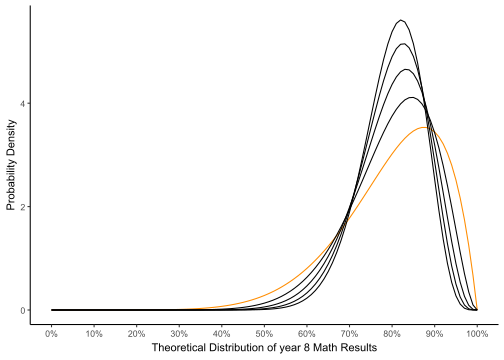
We see that the orange curve in Figure 3.1 above with a precision parameter of 10 is a reasonable starting point. Very few students fail year 8 math.
We can generate random numbers from this distribution using the R function rbeta(). The second equation simply shifts the year 8 results by 3% to reflect our knowledge that high school is typically more difficult. The third equation states that year 9 results are normally distributed with a mean that’s three percent lower than their result in year 8 and a standard deviation of 2%. It acts as random noise and we know that roughly 95% of the observations will be \(\pm4\)% of the mean. Note that we assume a 5% drop between year 9 and year 10 since year 10 is the first academic stream course.
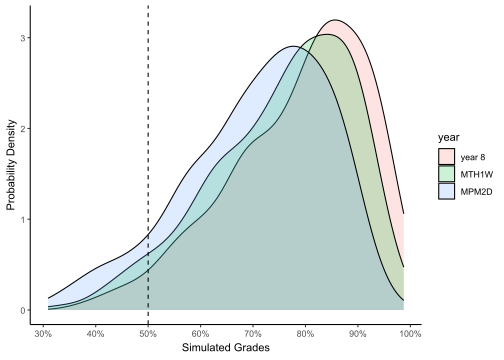
Let’s simulate 250 observations using our mathematical model.
set.seed(2025)

N <- 250
sim_grades <- tibble(
  y8 = rbeta(n = N, shape1 = 0.8*10, shape2 = (1-0.8)*10),
  mu9 = y8 - 0.03,
  y9 = rnorm(n = N, mean = mu9, sd = 0.02),
  mu10 = y9 - 0.05,
  y10 = rnorm(n = N, mean = mu10, sd = 0.02)
)sim_grades |>
pivot_longer(
cols = starts_with("y"),
names_to = "year",
values_to = "grade"
) |>
mutate(
year = factor(
year,
levels = c("y8", "y9", "y10"),
labels = c("year 8", "MTH1W", "MPM2D")
)) |>
ggplot(aes(x = grade, fill = year)) +
geom_density(alpha = 0.2) +
geom_vline(xintercept = 0.5, linetype = "dashed") +
scale_x_continuous(breaks = seq(0, 1, 0.1),labels = scales::percent) +
labs(
x = "Simulated Grades",
y = "Probability Density"
)
# Custom lower panel with regression line, equation, and styled points
lower_fun <- function(data, mapping, ...) {
ggplot(data = data, mapping = mapping) +
geom_point(shape = 1, alpha = 0.4, size = 1.5) +
geom_smooth(method = "lm", formula = 'y ~ x', se = FALSE, color = "steelblue") +
geom_abline(intercept = 0, slope = 1, linetype = "dashed") +
stat_poly_eq(
formula = y ~ x,
aes(label = after_stat(eq.label)),
parse = TRUE,
size = 3
) +
scale_x_continuous(labels = scales::percent, breaks = seq(-1,1, 0.25)) +
scale_y_continuous(labels = scales::percent, breaks = seq(-1,1, 0.250))
}
sim_grades |>
select(starts_with("y")) |>
ggpairs(lower = list(continuous = lower_fun))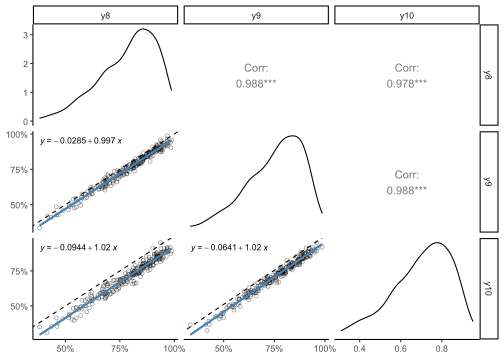
sim_grades |>
summary() y8 mu9 y9 mu10
Min. :0.3812 Min. :0.3512 Min. :0.3350 Min. :0.2850
1st Qu.:0.6945 1st Qu.:0.6645 1st Qu.:0.6683 1st Qu.:0.6183
Median :0.8145 Median :0.7845 Median :0.7819 Median :0.7319
Mean :0.7876 Mean :0.7576 Mean :0.7571 Mean :0.7071
3rd Qu.:0.8886 3rd Qu.:0.8586 3rd Qu.:0.8651 3rd Qu.:0.8151
Max. :0.9874 Max. :0.9574 Max. :0.9870 Max. :0.9370
y10
Min. :0.3091
1st Qu.:0.6189
Median :0.7307
Mean :0.7077
3rd Qu.:0.8097
Max. :0.9518 The distributions in Figure 3.2 roughly match my experience. All of them are left skewed with few students failing. As expected, we see that the correlation between year 9 and year 10 is stronger than the one between year 8 and year 10. That said, both correlations are very strong so we can add a bit more noise to the process.
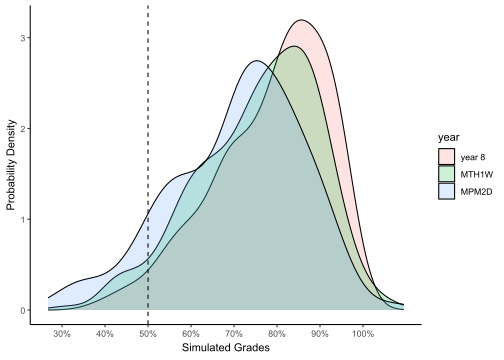
The noise problem can easily be addressed but the fact that some grades are bigger than 100% is a fatal issue for this model. We’ll see how we can address this problem in Section 3.2. Let’s change the standard deviations to 5% instead of 2% and see what we get.
set.seed(2025)
sim_grades <- tibble(
y8 = rbeta(n = N, shape1 = 0.8*10, shape2 = (1-0.8)*10),
mu9 = y8 - 0.03,
y9 = rnorm(n = N, mean = mu9, sd = 0.05),
mu10 = y9 - 0.05,
y10 = rnorm(n = N, mean = mu10, sd = 0.05)
)
sim_grades |>
  pivot_longer(
    cols = starts_with("y"),
    names_to = "year",
    values_to = "grade"
  ) |>
  mutate(
    year = factor(
      year,
      levels = c("y8", "y9", "y10"),
      labels = c("year 8", "MTH1W", "MPM2D")
      )) |>
  ggplot(aes(x = grade, fill = year)) +
  geom_density(alpha = 0.2) +
  geom_vline(xintercept = 0.5, linetype = "dashed") +
  scale_x_continuous(breaks = seq(0, 1, 0.1),labels = scales::percent) +
  labs(
    x = "Simulated Grades",
    y = "Probability Density"
  )
sim_grades |>
select(starts_with("y")) |>
ggpairs(lower = list(continuous = lower_fun))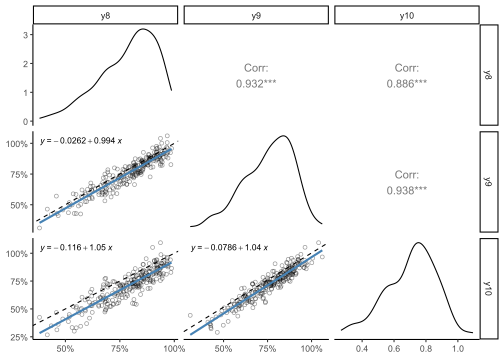
sim_grades |>
  summary()
y8 mu9 y9 mu10
Min. :0.3812 Min. :0.3512 Min. :0.3107 Min. :0.2607
1st Qu.:0.6945 1st Qu.:0.6645 1st Qu.:0.6645 1st Qu.:0.6145
Median :0.8145 Median :0.7845 Median :0.7739 Median :0.7239
Mean :0.7876 Mean :0.7576 Mean :0.7564 Mean :0.7064
3rd Qu.:0.8886 3rd Qu.:0.8586 3rd Qu.:0.8640 3rd Qu.:0.8140
Max. :0.9874 Max. :0.9574 Max. :1.0609 Max. :1.0109
y10
Min. :0.2674
1st Qu.:0.6017
Median :0.7296
Mean :0.7079
3rd Qu.:0.8159
Max. :1.0948 We see that our correlations are more realistic. However, more students in year 9 and 10 received grades over 100%. The top student in year 9 finished with 106% while the top student in year 10 finished with 109%! This is simply because, unlike the beta distribution, the normal distribution is not bounded between zero and one.
Since we need data to be bounded, let’s use a beta distribution to simulate the artificial data for all three grades.
\[x_{8i} \sim \text{Beta}(0.8 \cdot \phi, \, (1 - 0.8) \cdot \phi))\]
\[\mu_{9i} = x_{8i} - 0.03\] \[x_{9i} \sim \text{Beta}(\mu_{9i} \cdot \phi, \, (1 - \mu_{9i}) \cdot \phi)\] \[\mu_{10i} = x_{9i} - 0.05\] \[y_{10i} \sim \text{Beta}(\mu_{10i} \cdot \phi, \, (1 - \mu_{10i}) \cdot \phi)\]
Note that in model, year 10 results only depend on year 9 results which themselves depend on year 8 results. There’s no direct link between year 8 and year 10 grades like in DAG A of Figure 2.1.
set.seed(2025)
sim_grades <- tibble(
y8 = rbeta(n = N, shape1 = 0.8*10, shape2 = (1-0.8)*10),
mu9 = y8 - 0.03,
y9 = rbeta(n = N, shape1 = mu9*10, shape2 = (1-mu9)*10),
mu10 = y9 - 0.05,
y10 = rbeta(n = N, shape1 = mu10*10, shape2 = (1-mu10)*10)
)
sim_grades |>
pivot_longer(
cols = starts_with("y"),
names_to = "year",
values_to = "grade"
) |>
mutate(
year = factor(
year,
levels = c("y8", "y9", "y10"),
labels = c("year 8", "MTH1W", "MPM2D")
)) |>
ggplot(aes(x = grade, fill = year)) +
geom_density(alpha = 0.2) +
geom_vline(xintercept = 0.5, linetype = "dashed") +
scale_x_continuous(breaks = seq(0, 1, 0.1),labels = scales::percent) +
labs(
x = "Simulated Grades",
y = "Probability Density"
)
sim_grades |>
  select(starts_with("y")) |>
  ggpairs(lower = list(continuous = lower_fun))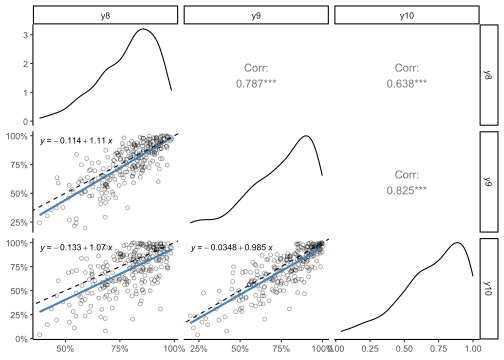
sim_grades |>
  summary()
y8 mu9 y9 mu10
Min. :0.3812 Min. :0.3512 Min. :0.1973 Min. :0.1473
1st Qu.:0.6945 1st Qu.:0.6645 1st Qu.:0.6414 1st Qu.:0.5914
Median :0.8145 Median :0.7845 Median :0.8014 Median :0.7514
Mean :0.7876 Mean :0.7576 Mean :0.7596 Mean :0.7096
3rd Qu.:0.8886 3rd Qu.:0.8586 3rd Qu.:0.9092 3rd Qu.:0.8592
Max. :0.9874 Max. :0.9574 Max. :0.9985 Max. :0.9485
y10
Min. :0.0380
1st Qu.:0.5845
Median :0.7480
Mean :0.7132
3rd Qu.:0.8848
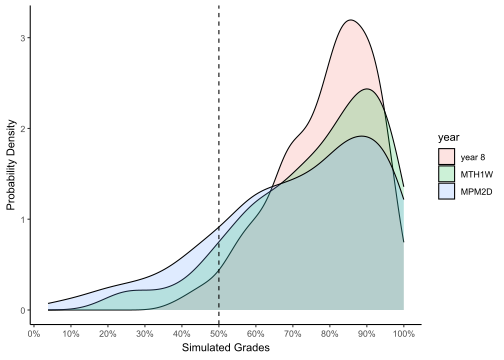
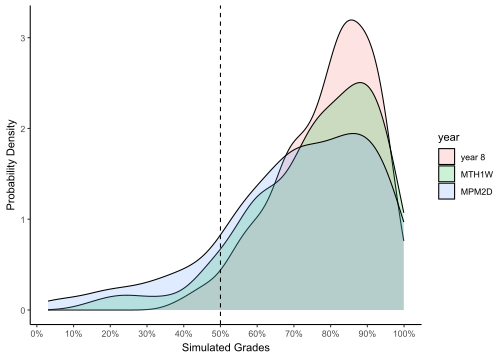
Max. :0.9999 We’ve fixed the issue of students getting over 100%. The correlations are realistic. What doesn’t match my prior knowledge is the shape of the distribution of grades. The peaks of the year 9 and 10 distributions are in the nineties which is even higher than for year 8 students. Ideally, the mode of the distributions would shift to the left with each subsequent year instead of stretching its left tail to achieve a lower mean.
In the previous model, we simply subtracted 3% from the grade in year 8 result and 5% from the year 9 result. We can now add slope parameters to our model and center our predictors by subtracting the mean.
\[x_{8i} \sim \text{Beta}(0.8 \cdot \phi, \, (1 - 0.8) \cdot \phi))\]
\[\mu_{9i} = \alpha_9 + \beta_1 (x_{8i} - \bar{x}_8)\] \[x_{9i} \sim \text{Beta}(\mu_{9i} \cdot \phi, \, (1 - \mu_{9i}) \cdot \phi)\] \[\mu_{10i} = \alpha_{10} + \beta_2 (x_{9i} - \bar{x}_9) \tag{3.1}\] \[y_{10i} \sim \text{Beta}(\mu_{10i} \cdot \phi, \, (1 - \mu_{10i}) \cdot \phi)\]
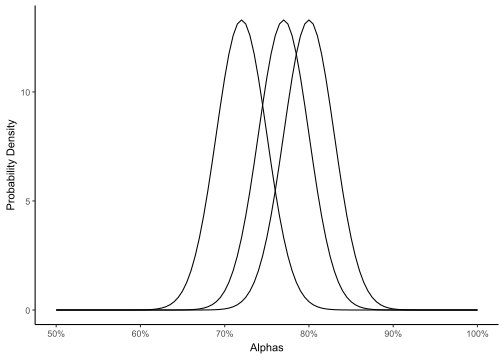
Centering our predictors allows for more meaningful interpretation of the parameters. Let’s consider the average student who finished with 80% in year 8. We get \(\mu_{9i} = \alpha_9 + \beta_1 (0.8 - 0.8) = \alpha_9 + \beta_1 (0) = \alpha_9\). Therefore, the \(\alpha\) parameters represent the average grade. With our assumption, \(\alpha_9 = 77\)% and \(\alpha_{10} = 72\)%. Of course, we don’t know these averages precisely and could represent our prior beliefs with the following priors for the \(\alpha\) parameters.
ggplot() +
stat_function(
fun = dnorm,
args = list(mean = 0.8, sd = 0.03),
xlim = c(0.5, 1)
) +
stat_function(
fun = dnorm,
args = list(mean = 0.77, sd = 0.03),
xlim = c(0.5, 1)
) +
stat_function(
fun = dnorm,
args = list(mean = 0.72, sd = 0.03),
xlim = c(0.5, 1)
) +
scale_x_continuous(breaks = seq(0, 1, 0.1),labels = scales::percent) +
labs(
x = "Alphas",
y = "Probability Density"
)
The \(\beta\) parameters are the amount that expected the year 9 result increases for every 1 unit increase in the year 8 grade. Not that all our data is between zero and one so we may want to divide our slopes by ten or one hundred for interpretability.
ggplot() +
stat_function(fun = function(x) {0.77+0*(x-0.8)}, xlim = c(0, 1)) +
stat_function(fun = function(x) {0.77+0.1*(x-0.8)}, xlim = c(0,1)) +
stat_function(fun = function(x) {0.77+0.2*(x-0.8)}, xlim = c(0,1)) +
stat_function(fun = function(x) {0.77+0.3*(x-0.8)}, xlim = c(0,1)) +
stat_function(fun = function(x) {0.77+0.4*(x-0.8)}, xlim = c(0,1)) +
stat_function(fun = function(x) {0.77+0.5*(x-0.8)}, xlim = c(0,1)) +
stat_function(fun = function(x) {0.77+0.6*(x-0.8)}, xlim = c(0,1)) +
stat_function(fun = function(x) {0.77+0.7*(x-0.8)}, xlim = c(0,1)) +
stat_function(fun = function(x) {0.77+0.8*(x-0.8)}, xlim = c(0,1)) +
stat_function(fun = function(x) {0.77+0.9*(x-0.8)}, xlim = c(0,1)) +
stat_function(fun = function(x) {0.77+1*(x-0.8)},
xlim = c(0,1), color = "darkorange") +
stat_function(fun = function(x) {0.77+1.1*(x-0.8)}, xlim = c(0,1)) +
stat_function(fun = function(x) {0.77+1.2*(x-0.8)}, xlim = c(0,1)) +
geom_abline(intercept = 0, slope = 1, linetype = "dashed") +
geom_label(aes(x = 0.8, y = 0.85), label = "Average student") +
scale_x_continuous(labels = scales::percent, breaks = seq(0, 1, 0.1)) +
scale_y_continuous(labels = scales::percent, breaks = seq(0, 1, 0.1)) +
labs(
x = "year 8 Grade",
y = "year 9 Grade"
)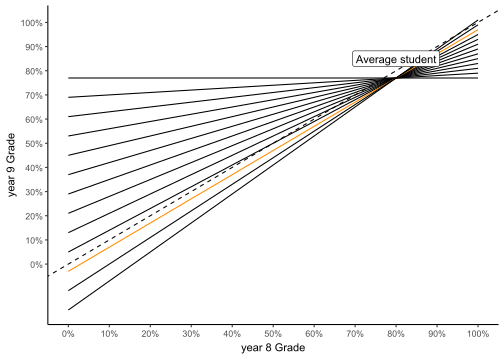
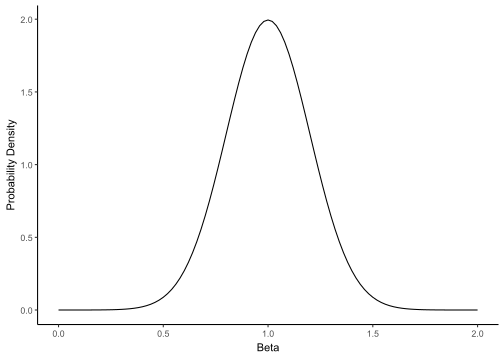
Figure 3.5 shows the equation \(y_9 = 0.77 + \beta(x - 0.8)\) for \(\beta \in [0, 0.1, 0.2, ..., 1.2]\). The orange line is where \(\beta = 1\) and the dashed line is the equation \(y=x\). We know intuitively that reasonable values of \(\beta\) are going to be close to 1 so we could set our prior as \(\beta \sim N(\mu = 1, \sigma = 0.2\) which can be visualized as in Figure 3.6.
ggplot() +
stat_function(
fun = dnorm,
args = list(mean = 1, sd = 0.2),
xlim = c(0, 2)
) +
labs(
x = "Beta",
y = "Probability Density"
)
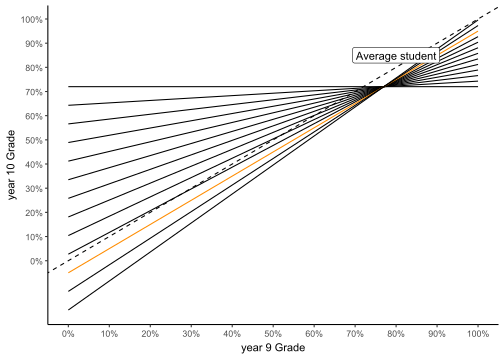
Repeating the same procedure for the slope coefficient between year 9 and year 10 we see that values slightly larger than one might make more sense here so we’ll code it as 1.1 in the simulation.
ggplot() +
stat_function(fun = function(x){0.72+0*(x-0.8)}, xlim = c(0, 1)) +
stat_function(fun = function(x){0.72+0.1*(x-0.77)}, xlim = c(0,1)) +
stat_function(fun = function(x){0.72+0.2*(x-0.77)}, xlim = c(0,1)) +
stat_function(fun = function(x){0.72+0.3*(x-0.77)}, xlim = c(0,1)) +
stat_function(fun = function(x){0.72+0.4*(x-0.77)}, xlim = c(0,1)) +
stat_function(fun = function(x){0.72+0.5*(x-0.77)}, xlim = c(0,1)) +
stat_function(fun = function(x){0.72+0.6*(x-0.77)}, xlim = c(0,1)) +
stat_function(fun = function(x){0.72+0.7*(x-0.77)}, xlim = c(0,1)) +
stat_function(fun = function(x){0.72+0.8*(x-0.77)}, xlim = c(0,1)) +
stat_function(fun = function(x){0.72+0.9*(x-0.77)}, xlim = c(0,1)) +
stat_function(fun = function(x){0.72+1*(x-0.77)},
xlim = c(0,1), color = "darkorange") +
stat_function(fun = function(x){0.72+1.1*(x-0.77)}, xlim = c(0,1)) +
stat_function(fun = function(x){0.72+1.2*(x-0.77)}, xlim = c(0,1)) +
geom_abline(intercept = 0, slope = 1, linetype = "dashed") +
geom_label(aes(x = 0.8, y = 0.85), label = "Average student") +
scale_x_continuous(labels = scales::percent, breaks = seq(0, 1, 0.1)) +
scale_y_continuous(labels = scales::percent, breaks = seq(0, 1, 0.1)) +
labs(
x = "year 9 Grade",
y = "year 10 Grade"
)
set.seed(2025)
sim_grades <- tibble(
y8 = rbeta(n = N, shape1 = 0.8*10, shape2 = (1-0.8)*10),
mu9 = 0.77 + 0.9* (y8 - mean(y8)),
y9 = rbeta(n = N, shape1 = mu9*10, shape2 = (1-mu9)*10),
mu10 = 0.72 + 1 * (y9 - mean(y9)),
y10 = rbeta(n = N, shape1 = mu10*10, shape2 = (1-mu10)*10)
)
sim_grades |>
pivot_longer(
cols = starts_with("y"),
names_to = "year",
values_to = "grade"
) |>
mutate(
year = factor(
year,
levels = c("y8", "y9", "y10"),
labels = c("year 8", "MTH1W", "MPM2D")
)) |>
ggplot(aes(x = grade, fill = year)) +
geom_density(alpha = 0.2) +
geom_vline(xintercept = 0.5, linetype = "dashed") +
scale_x_continuous(breaks = seq(0, 1, 0.1),labels = scales::percent) +
labs(
x = "Simulated Grades",
y = "Probability Density"
)
sim_grades |>
  select(starts_with("y")) |>
  ggpairs(lower = list(continuous = lower_fun))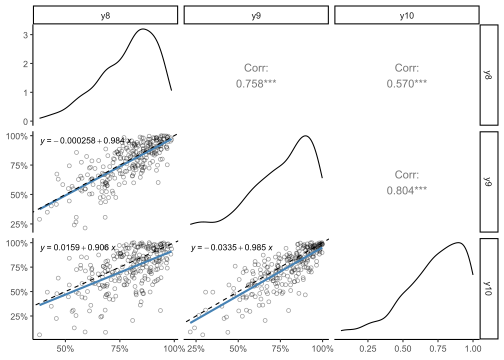
sim_grades |>
  summary()
y8 mu9 y9 mu10
Min. :0.3812 Min. :0.4042 Min. :0.2155 Min. :0.1608
1st Qu.:0.6945 1st Qu.:0.6863 1st Qu.:0.6690 1st Qu.:0.6143
Median :0.8145 Median :0.7943 Median :0.8123 Median :0.7577
Mean :0.7876 Mean :0.7700 Mean :0.7747 Mean :0.7200
3rd Qu.:0.8886 3rd Qu.:0.8610 3rd Qu.:0.9110 3rd Qu.:0.8563
Max. :0.9874 Max. :0.9499 Max. :0.9982 Max. :0.9435
y10
Min. :0.05754
1st Qu.:0.60919
Median :0.76373
Mean :0.72970
3rd Qu.:0.89169
Max. :0.99984 Let’s add the term \(\beta_3 \cdot (x_{9i} - \bar{x}_9)\) to Equation 3.1 to introduce a direct effect of year 8 and year 10 as depicted in Figure 2.3.
\[x_{8i} \sim \text{Beta}(0.8 \cdot \phi, \, (1 - 0.8) \cdot \phi))\]
\[\mu_{9i} = \alpha_9 + \beta_1 \cdot (x_{8i} - \bar{x}_8)\]
\[x_{9i} \sim \text{Beta}(\mu_{9i} \cdot \phi_9,\ (1 - \mu_{9i}) \cdot \phi_9)\]
\[\mu_{10i} = \alpha_{10} + \beta_2 \cdot (x_{8i} - \bar{x}_8) + \beta_3 \cdot (x_{9i} - \bar{x}_9)\]
\[y_{10i} \sim \text{Beta}(\mu_{10i} \cdot \phi_{10},\ (1 - \mu_{10i}) \cdot \phi_{10})\] We see that \(\mu_{10}\) now directly depends on both year 9 and year 8 results. We can also interpret the \(\beta\) slope parameters as causal effects if we assume that DAG B is the true data-generating model. Here’s how to interpret the coefficients :
The difficult thing is to set reasonable priors for these \(\beta\) parameters. We expect for example that grades are positively correlated and, hence, the slopes should be positive. We also expect the direct effect of year 8 on year 9, \(\beta_1\), to be close to one. We expect the direct effect of year 8 on year 10 to be relatively small since the total of year 8 on year 10 to be mostly mediated by year 9.
Let’s consider a student who finished with 70% in year 8 and 67% in year 9. We expect this student to score around 62% in year 10. We can use the code below tho try out meta different values of \(\beta_2\) and \(\beta_3\) to see which range of parameters produce reasonable results.
# Constants
mean_x8 <- 0.80
mean_x9 <- 0.77
alpha_10 <- 0.72
beta_2 <- seq(0, 2, by = 0.01)
beta_3 <- seq(0, 2, by = 0.01)
# Define vector of x8 values
x8_vals <- c(0.55, 0.6, 0.65, 0.7, 0.75, 0.85, 0.90, 0.95, 1)
# Function to generate plot for a given x8
generate_plot <- function(x8) {
x9 <- x8 - 0.03
x10_expected <- x9 - 0.05
expand.grid(beta_2 = beta_2, beta_3 = beta_3) |>
mutate(
mu10 = alpha_10 + beta_2 * (x8 - mean_x8) + beta_3 * (x9 - mean_x9)
) |>
filter(
mu10 >= x10_expected - 0.1,
mu10 <= x10_expected + 0.1,
beta_3 > beta_2
) |>
ggplot(aes(x = beta_2, y = beta_3)) +
geom_tile(aes(fill = mu10)) +
geom_contour(aes(z = mu10), breaks = x10_expected + 0.02 * c(-1, 1), color = "red", linewidth = 1) +
geom_abline() +
scale_fill_viridis_c(labels = scales::percent_format(accuracy = 1)) +
labs(
title = paste0("x8 = ", scales::percent(x8, accuracy = 1)),
x = expression(beta[2]),
y = expression(beta[3]),
fill = expression(mu[10])
)
}
# Combine all plots into a grid
plots <- map(x8_vals, generate_plot)
wrap_plots(plots, ncol = 3)
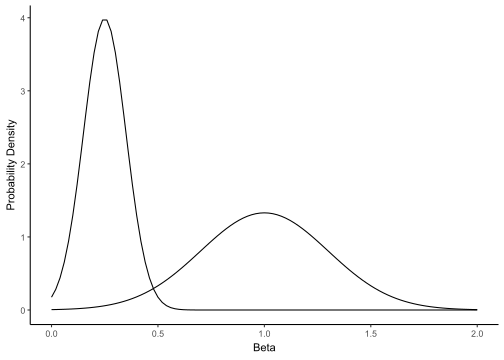
We did we skip 80% in Figure 3.7? It’s because 80% is the average of year 8 so we’d only output the expected grade in year 10 of 72%. The previous plot tells that plausible values for \(\beta_2\) are between 0 and 0.5 and the ones for \(\beta_3\) are between 0.5 and 1.5. Thus, could set the following priors for \(\beta_2\) and \(\beta_3\).
ggplot() +
stat_function(
fun = dnorm,
args = list(mean = 0.25, sd = 0.1),
xlim = c(0, 2)
) +
stat_function(
fun = dnorm,
args = list(mean = 1, sd = 0.3),
xlim = c(0, 2)
) +
labs(
x = "Beta",
y = "Probability Density"
)
set.seed(2025)
sim_grades <- tibble(
y8 = rbeta(n = N, shape1 = 0.8*10, shape2 = (1-0.8)*10),
mu9 = 0.77 + 0.9 * (y8 - mean(y8)),
y9 = rbeta(n = N, shape1 = mu9 * 10, shape2 = (1 - mu9) * 10),
mu10 = 0.72 + 0.2 * (y8 - mean(y8)) + 0.9 * (y9 - mean(y9)),
y10 = rbeta(n = N, shape1 = mu10 * 10, shape2 = (1 - mu10) * 10),
)
sim_grades |>
pivot_longer(
cols = starts_with("y"),
names_to = "year",
values_to = "grade"
) |>
mutate(
year = factor(
year,
levels = c("y8", "y9", "y10"),
labels = c("year 8", "MTH1W", "MPM2D")
)) |>
ggplot(aes(x = grade, fill = year)) +
geom_density(alpha = 0.2) +
geom_vline(xintercept = 0.5, linetype = "dashed") +
scale_x_continuous(breaks = seq(0, 1, 0.1),labels = scales::percent) +
labs(
x = "Simulated Grades",
y = "Probability Density"
)
sim_grades |>
  select(starts_with("y")) |>
  ggpairs(lower = list(continuous = lower_fun))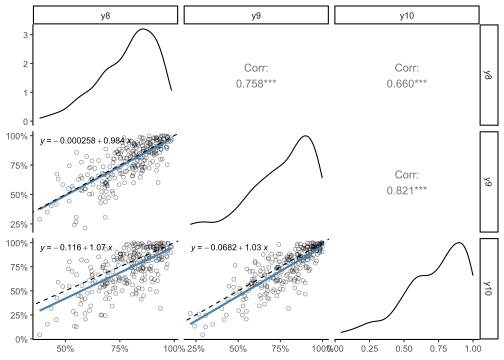
sim_grades |>
  summary()
y8 mu9 y9 mu10
Min. :0.3812 Min. :0.4042 Min. :0.2155 Min. :0.1773
1st Qu.:0.6945 1st Qu.:0.6863 1st Qu.:0.6690 1st Qu.:0.6108
Median :0.8145 Median :0.7943 Median :0.8123 Median :0.7548
Mean :0.7876 Mean :0.7700 Mean :0.7747 Mean :0.7200
3rd Qu.:0.8886 3rd Qu.:0.8610 3rd Qu.:0.9110 3rd Qu.:0.8608
Max. :0.9874 Max. :0.9499 Max. :0.9982 Max. :0.9554
y10
Min. :0.04241
1st Qu.:0.59311
Median :0.77903
Mean :0.72853
3rd Qu.:0.89926
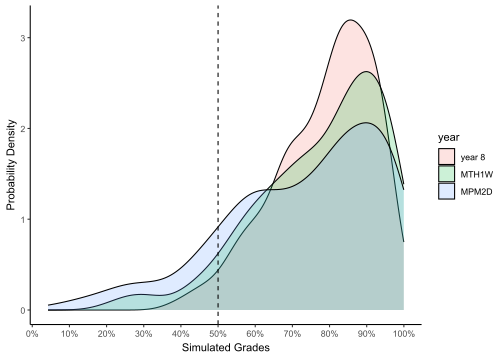
Max. :0.99979 The simulated data from this model produces realistic results which gives us more confidence of our choice of priors.
Although it’s unlikely, it’s technically possible for the model above to generate errors. Consider a year 8 student who finishes the course with a 2%.
\[\mu_{9i} = x_{8i} - 0.03 = 0.02 - 0.03 = -0.01\]
The beta distribution can’t accept negative mean values. For this reason, we’ll use the logit (log odds) link function instead of subtracting 3% from the previous grade: \[\text{logit}(\mu_{9i}) = \ln\left({\frac{\mu_{9i}}{1-\mu_{9i}}}\right)= \alpha_9 + \beta_1 \cdot (x_{8i} - \bar{x}_8) \tag{3.2}\]
We can solve for \(\mu_{9i}\) by exponentiating both sides of the equations :
\[\mu_{9i} = \frac{e^{\alpha_9 + \beta_1 \cdot (x_{8i} - \bar{x}_8)}}{1+e^{\alpha_9 + \beta_1 \cdot (x_{8i} - \bar{x}_8)}} = \frac{1}{1+e^{-(\alpha_9 + \beta_1 \cdot (x_{8i} - \bar{x}_8))}}\] Visualizing these inverse functions is a good way to develop our intuition.
p_1 <- ggplot() +
stat_function(
fun = function(x){exp(x) / (1 + exp(x))}, # plogis(x)
xlim = c(-5, 5)
) +
labs(
title = "Logistic Function (plogis)",
x = "log-odds scale",
y = "probability scale"
)
p_2 <- ggplot() +
stat_function(
fun = function(x){log(x / (1 - x))}, #qlogis(x)
xlim = c(0, 1)
) +
labs(
title = "Logit Function (qlogis)",
x = "probability scale",
y = "log-odds scale"
)
p_1 + p_2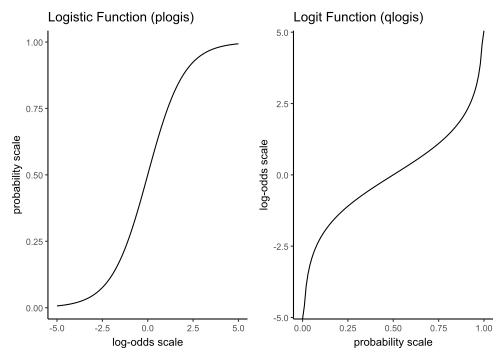
We see that no matter what you input in the logistic function \(\mu(x) = \frac{e^x}{1+e^x}\) you’ll get a number that is between zero and one. That is, the domain of \(\mu(x)\) is \((-\infty, +\infty)\) and its range is \((0, 1)\). The input of \(\mu(x)\) is \(\alpha_9 + \beta_1 \cdot (x - \bar{x}_8)\) where \(\alpha_9\) and \(\beta_1\) are constant parameters and \(x\) is the result in year 8 and \(\bar{x}_8)\) is the average of the year 8 class which we assumed was 80%. Note that the logistic function in R is plogis() and the logit function is qlogis(). How are we suppose to assign reasonable values to \(\alpha_9\) and \(\beta_1\)?
Let’s start with the \(\alpha_9\) parameter and consider the average student in year 8 who finished with 80%.
\[\mu_{9_{avg}} = \frac{e^{\alpha_9 + \beta_1 \cdot (0.8 - 0.8)}}{1+e^{\alpha_9 + \beta_1 \cdot (0.8 -0.8)}} = \frac{e^{\alpha_9 + \beta_1 \cdot 0}}{1+e^{\alpha_9 + \beta_1 \cdot 0}} = \frac{e^{\alpha_9}}{1+e^{\alpha_9}}\]
qlogis(0.77)[1] 1.208311plogis(qlogis(0.77))[1] 0.77plogis(1.21)[1] 0.7702989As we did in previous simulations, let’s assume that the year 9 average is 3% lower than the year 8 average. Therefore, the average year 8 student would finish with a 77% plus-minus some noise. Solving for \(\alpha_9\) we get:
\[0.77 = \frac{e^{\alpha_9}}{1+e^{\alpha_9}}\] \[0.77 \cdot (1+e^{\alpha_9}) = e^{\alpha_9}\] \[0.77 + 0.77 \cdot e^{\alpha_9} = e^{\alpha_9}\] \[0.77 = e^{\alpha_9} - 0.77 \cdot e^{\alpha_9}\] \[0.77 = e^{\alpha_9} (1 - 0.77)\] \[e^{\alpha_9} = \frac{0.77}{1 - 0.77}\] \[\alpha_9 = \ln \left( \frac{0.77}{1 - 0.77} \right) \approx 1.21\]
ggplot() +
stat_function(
fun = plogis,
xlim = c(-5, 5)
) +
geom_segment(
aes(
x = c(-5, -5), xend = c(qlogis(0.55), qlogis(0.89)),
y = c(0.55, 0.89), yend = c(0.55, 0.89)),
linetype = "dashed"
) +
geom_segment(
aes(
x = c(qlogis(0.55), qlogis(0.89)), xend = c(qlogis(0.55), qlogis(0.89)),
y = c(0, 0), yend = c(0.55, 0.89)),
linetype = "dashed"
) +
labs(
x = "Reasonable values for alpha",
y = "Average Grade"
)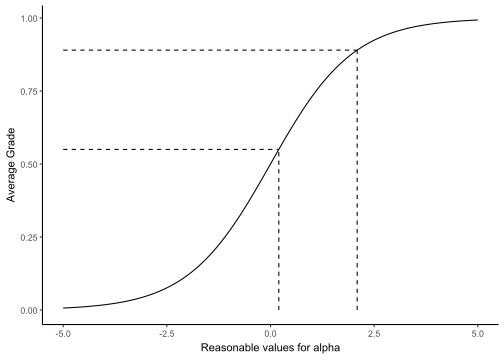
Given that class average in Ontario tend to hover between 55% and 85%, Figure 3.8 shows that the associated range for plausible alpha values would be between 0.2 and 1.73.
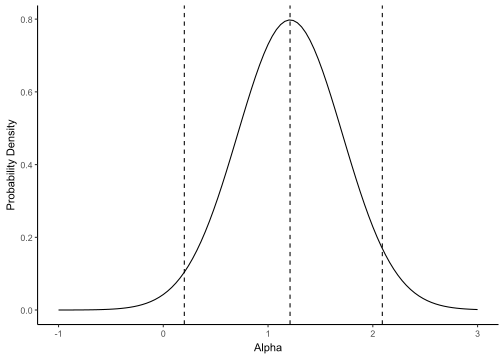
We can express our understanding of alpha with the following prior distribution.
\[ \alpha \sim N(\mu = 1.21, \sigma = 0.5) \]
ggplot() +
stat_function(
fun = dnorm,
args = list(mean = 1.21, sd = 0.5),
xlim = c(-1, 3)
) +
geom_vline(
xintercept = c(qlogis(0.55), 1.21, qlogis(0.89)),
linetype = "dashed") +
labs(
x = "Alpha",
y = "Probability Density"
)
Now that we have \(\alpha_9 \approx 1.21\), we need to find plausible values for \(\beta_1\). By inspecting Equation 3.2, we see that \(\beta_1\) is the slope parameter for the log-odds. If \(\beta_1 = 0\)
ggplot() +
stat_function(fun = function(x) plogis(1.21+-1*(x - 0.8)), xlim = c(0, 1)) +
stat_function(fun = function(x) plogis(1.21+0*(x - 0.8)), xlim = c(0, 1)) +
stat_function(fun = function(x) plogis(1.21+1*(x - 0.8)), xlim = c(0, 1)) +
stat_function(fun = function(x) plogis(1.21+2*(x - 0.8)), xlim = c(0, 1)) +
stat_function(fun = function(x) plogis(1.21+3*(x - 0.8)), xlim = c(0, 1)) +
stat_function(fun = function(x) plogis(1.21+4*(x - 0.8)), xlim = c(0, 1)) +
stat_function(fun = function(x) plogis(1.21+5*(x - 0.8)),
xlim = c(0, 1), color = "darkorange") +
stat_function(fun = function(x) plogis(1.21+6*(x - 0.8)), xlim = c(0, 1)) +
stat_function(fun = function(x) plogis(1.21+7*(x - 0.8)), xlim = c(0, 1)) +
stat_function(fun = function(x) plogis(1.21+8*(x - 0.8)), xlim = c(0, 1)) +
geom_abline(intercept = 0, slope = 1, linetype = "dashed") +
geom_label(aes(x = 0.8, y = 0.77), label = "Average student") +
scale_x_continuous(labels = scales::percent, breaks = seq(0, 1, 0.1)) +
scale_y_continuous(labels = scales::percent, breaks = seq(0, 1, 0.1)) +
labs(
x = "year 8 Grade",
y = "year 9 Grade"
)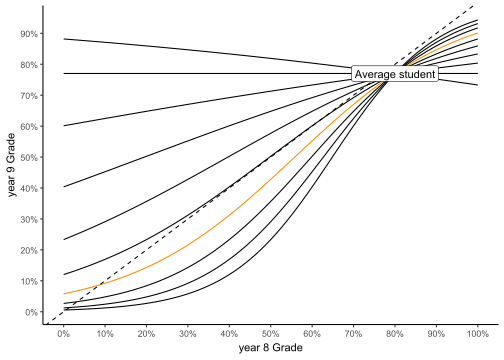
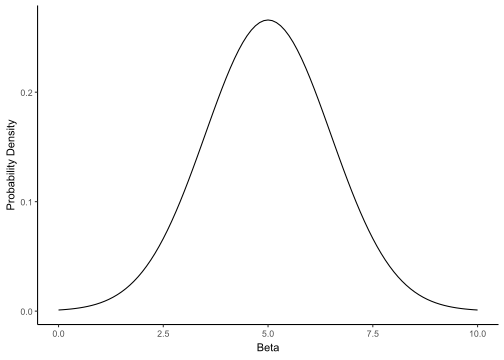
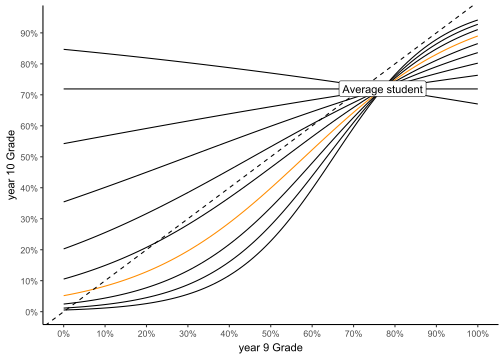
Figure 3.10 shows 10 different curves for \(\mu_9 = \frac{1}{1+e^{-(1.21 + \beta_1 \cdot (x_{8i} - 0.8))}}\) where \(\beta_1 \in [-1, 0, 1, 2, 3, 4, 5, 6, 7, 8]\). The orange curve is for \(\beta_1 = 5\). The point of intersection of all curves is the performance of the average student (80% in year 8 and 77% in year 9). \(\beta_1 < 0\) implies that there is a negative relationship between the grades. This doesn’t make sense. Kids who score high in year 8 tend to score high in year 9 even tho it make be a bit lower than their previous grade. As seen in Figure 3.10, the most plausible values of \(\beta_1\) are around 5. The dashed diagonal line represents the equation \(y = x\) which indicates that students perform equally well in the following courses which tends to not be what we observe in the classroom.
Given what we know about the data-generating process we can express our prior belief as follows:
\[ \beta \sim N(\mu = 5, \sigma = 1.5) \]
ggplot() +
stat_function(
fun = dnorm,
args = list(mean = 5, sd = 1.5),
xlim = c(0, 10)
) +
labs(
x = "Beta",
y = "Probability Density"
)
It’s technically not impossible for the slope to be negative in practice so we’ll allow the possibility while limiting the prior probability mass assigned to that range of possibility.
Let’s now fully write the mathematical model represented in DAG A of Figure 2.1.
\[x_{8i} \sim \text{Beta}(0.8 \cdot \phi, \, (1 - 0.8) \cdot \phi))\]
\[\text{logit}(\mu_{9i}) = \alpha_9 + \beta_1 \cdot (x_{8i} - \bar{x}_8)\]
\[x_{9i} \sim \text{Beta}(\mu_{9i} \cdot \phi_9,\ (1 - \mu_{9i}) \cdot \phi_9)\]
\[\text{logit}(\mu_{10i}) = \alpha_{10} + \beta_2 \cdot(x_{9i} - \bar{x}_9) \tag{3.3}\]
\[y_{10i} \sim \text{Beta}(\mu_{10i} \cdot \phi_{10},\ (1 - \mu_{10i}) \cdot \phi_{10})\] Note that there’s no direct effect of year 8 on year 10. All of it’s effect is mediated by the year 9 results. As discussed earlier, DAG B is likely a better model and we’ll see how we can build it’s corresponding model in Section 3.6.
qlogis(0.72)[1] 0.9444616ggplot() +
stat_function(fun = function(x) plogis(0.94+-1*(x - 0.77)), xlim = c(0, 1)) +
stat_function(fun = function(x) plogis(0.94+0*(x - 0.77)), xlim = c(0, 1)) +
stat_function(fun = function(x) plogis(0.94+1*(x - 0.77)), xlim = c(0, 1)) +
stat_function(fun = function(x) plogis(0.94+2*(x - 0.77)), xlim = c(0, 1)) +
stat_function(fun = function(x) plogis(0.94+3*(x - 0.77)), xlim = c(0, 1)) +
stat_function(fun = function(x) plogis(0.94+4*(x - 0.77)), xlim = c(0, 1)) +
stat_function(fun = function(x) plogis(0.94+5*(x - 0.77)),
xlim = c(0, 1), color = "darkorange") +
stat_function(fun = function(x) plogis(0.94+6*(x - 0.77)), xlim = c(0, 1)) +
stat_function(fun = function(x) plogis(0.94+7*(x - 0.77)), xlim = c(0, 1)) +
stat_function(fun = function(x) plogis(0.94+8*(x - 0.77)), xlim = c(0, 1)) +
geom_abline(intercept = 0, slope = 1, linetype = "dashed") +
geom_label(aes(x = 0.77, y = 0.72), label = "Average student") +
scale_x_continuous(labels = scales::percent, breaks = seq(0, 1, 0.1)) +
scale_y_continuous(labels = scales::percent, breaks = seq(0, 1, 0.1)) +
labs(
x = "year 9 Grade",
y = "year 10 Grade"
)
set.seed(2025)
sim_grades <- tibble(
y8 = rbeta(n = N, shape1 = 0.8*10, shape2 = (1-0.8)*10),
mu8 = plogis(1.21 + 5 * (y8 - mean(y8))),
y9 = rbeta(n = N, shape1 = mu8 * 10, shape2 = (1 - mu8) * 10),
mu9 = plogis(0.94 + 4 * (y9 - mean(y9))),
y10 = rbeta(n = N, shape1 = mu9 * 10, shape2 = (1 - mu9) * 10),
)
sim_grades |>
pivot_longer(
cols = starts_with("y"),
names_to = "year",
values_to = "grade"
) |>
mutate(
year = factor(
year,
levels = c("y8", "y9", "y10"),
labels = c("year 8", "MTH1W", "MPM2D")
)) |>
ggplot(aes(x = grade, fill = year)) +
geom_density(alpha = 0.2) +
geom_vline(xintercept = 0.5, linetype = "dashed") +
scale_x_continuous(breaks = seq(0, 1, 0.1),labels = scales::percent) +
labs(
x = "Simulated Grades",
y = "Probability Density"
)
sim_grades |>
  select(starts_with("y")) |>
  ggpairs(lower = list(continuous = lower_fun))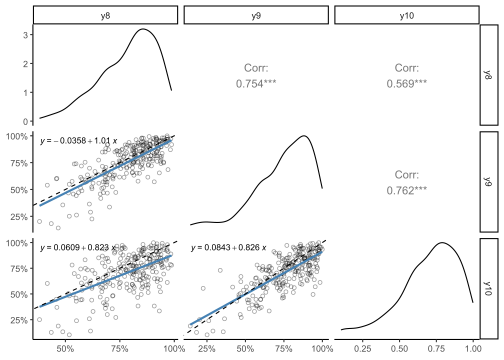
sim_grades |>
  summary()
y8 mu8 y9 mu9
Min. :0.3812 Min. :0.3053 Min. :0.1413 Min. :0.1792
1st Qu.:0.6945 1st Qu.:0.6781 1st Qu.:0.6502 1st Qu.:0.6258
Median :0.8145 Median :0.7933 Median :0.7844 Median :0.7409
Mean :0.7876 Mean :0.7529 Mean :0.7567 Mean :0.7039
3rd Qu.:0.8886 3rd Qu.:0.8475 3rd Qu.:0.8935 3rd Qu.:0.8157
Max. :0.9874 Max. :0.9011 Max. :0.9993 Max. :0.8711
y10
Min. :0.1025
1st Qu.:0.6007
Median :0.7398
Mean :0.7092
3rd Qu.:0.8506
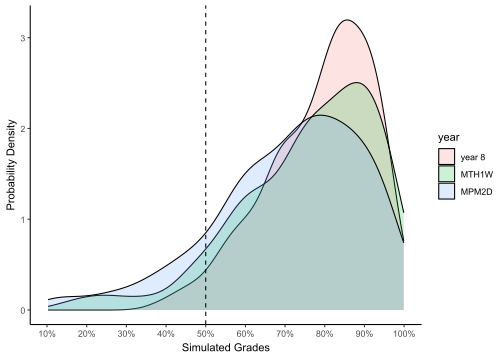
Max. :0.9986 We see that the summary statistics, the correlations and the distributions are sensible. The only thing missing is the direct influence of year 8 results on year 10 results. Let’s fix this in the next section.
Let’s add the term \(\beta_3 \cdot (x_{9i} - \bar{x}_9)\) to Equation 3.3 to introduce a direct effect of year 8 and year 10 as depicted in Figure 2.3.
\[x_{8i} \sim \text{Beta}(0.8 \cdot \phi, \, (1 - 0.8) \cdot \phi))\]
\[\text{logit}(\mu_{9i}) = \alpha_9 + \beta_1 \cdot (x_{8i} - \bar{x}_8)\]
\[x_{9i} \sim \text{Beta}(\mu_{9i} \cdot \phi_9,\ (1 - \mu_{9i}) \cdot \phi_9)\]
\[\text{logit}(\mu_{10i}) = \alpha_{10} + \beta_2 \cdot (x_{8i} - \bar{x}_8) + \beta_3 \cdot (x_{9i} - \bar{x}_9)\]
\[y_{10i} \sim \text{Beta}(\mu_{10i} \cdot \phi_{10},\ (1 - \mu_{10i}) \cdot \phi_{10})\] How to set reasonable values for \(\beta_2\) and \(\beta_3\)?
# Inputs
x8 <- 0.71
x9 <- 0.68
mean_x8 <- 0.80
mean_x9 <- 0.77
alpha_10 <- 0.94
beta_2 <- seq(0, 10, by = 0.5)
beta_3 <- seq(0, 10, by = 0.5)
# Generate grid of all combinations
grid <- expand.grid(beta_2 = beta_2, beta_3 = beta_3)
# Compute mu_10 on the logit and probability scale
grid <- grid |>
mutate(
logit_mu10 = alpha_10 + beta_2 * (x8 - mean_x8) + beta_3 * (x9 - mean_x9),
mu10 = plogis(logit_mu10) # inverse logit
)
plausible_betas <- grid |>
filter(mu10 <= 0.68, mu10 >= 0.58, beta_3 > beta_2)
# Plot with contour around the region mu10 ∈ [0.55, 0.70]
ggplot(grid, aes(x = beta_2, y = beta_3, fill = mu10)) +
geom_tile() +
geom_contour(aes(z = mu10), breaks = c(0.58, 0.68), color = "white") +
geom_abline(color = "white") +
scale_fill_viridis_c(labels = scales::percent_format(accuracy = 1)) +
labs(
title = expression(paste("Prior Predictive: ", mu[10], " as a function of ", beta[2], " and ", beta[3])),
x = expression(beta[2]),
y = expression(beta[3]),
fill = expression(mu[10])
) +
theme_minimal()
summary(plausible_betas) beta_2 beta_3 logit_mu10 mu10
Min. :0.000 Min. :1.500 Min. :0.3550 Min. :0.5878
1st Qu.:0.500 1st Qu.:3.000 1st Qu.:0.4000 1st Qu.:0.5987
Median :1.000 Median :3.500 Median :0.4900 Median :0.6201
Mean :1.035 Mean :3.814 Mean :0.5036 Mean :0.6229
3rd Qu.:1.500 3rd Qu.:4.500 3rd Qu.:0.5800 3rd Qu.:0.6411
Max. :3.000 Max. :6.500 Max. :0.7150 Max. :0.6715 set.seed(2025)
sim_grades <- tibble(
y8 = rbeta(n = N, shape1 = 0.8*10, shape2 = (1-0.8)*10),
mu9 = plogis(1.21 + 5 * (y8 - mean(y8))),
y9 = rbeta(n = N, shape1 = mu9 * 10, shape2 = (1 - mu9) * 10),
mu10 = plogis(0.94 + 1.2 * (y8 - mean(y8)) + 4.35 * (y9 - mean(y9))),
y10 = rbeta(n = N, shape1 = mu10 * 10, shape2 = (1 - mu10) * 10),
)
#write_csv(sim_grades, file = "sim_grades.csv")
sim_grades |>
pivot_longer(
cols = starts_with("y"),
names_to = "year",
values_to = "grade"
) |>
mutate(
year = factor(
year,
levels = c("y8", "y9", "y10"),
labels = c("year 8", "MTH1W", "MPM2D")
)) |>
ggplot(aes(x = grade, fill = year)) +
geom_density(alpha = 0.2) +
geom_vline(xintercept = 0.5, linetype = "dashed") +
scale_x_continuous(breaks = seq(0, 1, 0.1),labels = scales::percent) +
labs(
x = "Simulated Grades",
y = "Probability Density"
)
sim_grades |>
  select(starts_with("y")) |>
  ggpairs(lower = list(continuous = lower_fun))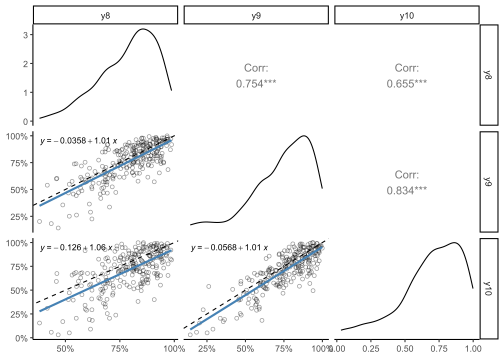
sim_grades |>
  summary()
y8 mu9 y9 mu10
Min. :0.3812 Min. :0.3053 Min. :0.1413 Min. :0.1070
1st Qu.:0.6945 1st Qu.:0.6781 1st Qu.:0.6502 1st Qu.:0.6061
Median :0.8145 Median :0.7933 Median :0.7844 Median :0.7588
Mean :0.7876 Mean :0.7529 Mean :0.7567 Mean :0.6976
3rd Qu.:0.8886 3rd Qu.:0.8475 3rd Qu.:0.8935 3rd Qu.:0.8340
Max. :0.9874 Max. :0.9011 Max. :0.9993 Max. :0.9012
y10
Min. :0.03041
1st Qu.:0.58798
Median :0.73727
Mean :0.70746
3rd Qu.:0.87299
Max. :0.99867