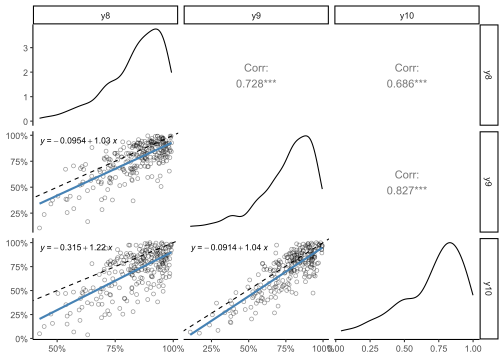
# Load librarieslibrary(tidyverse)library(dagitty)library(ggdag)library(GGally)library(ggpmisc)library(gt)library(cmdstanr)library(tidybayes)library(ggridges)library(loo)#library(posterior)# Set ggplot themetheme_set(theme_classic())# Create a function to convert decimals to percentagesto_percent <-function(x, digits =0){return(round(x *100, digits = digits))}# Custom lower panel with regression line, equation, and styled pointslower_fun <-function(data, mapping, ...) {ggplot(data = data, mapping = mapping) +geom_point(shape =1, alpha =0.4, size =1.5) +geom_smooth(method ="lm", formula ='y ~ x', se =FALSE, color ="steelblue") +geom_abline(intercept =0, slope =1, linetype ="dashed") +stat_poly_eq(formula = y ~ x,aes(label =after_stat(eq.label)),parse =TRUE,size =3 ) +scale_x_continuous(labels = scales::percent, breaks =seq(-1,1, 0.25)) +scale_y_continuous(labels = scales::percent, breaks =seq(-1,1, 0.250))}
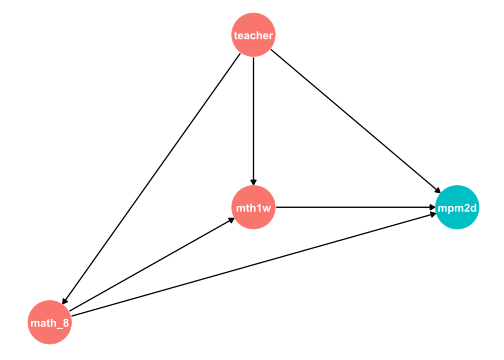
It’s sensible to assume that the teacher has a systematic impact on student achievement for two reasons. First, they are often the ones grading students and some teachers can be more lenient or harsher graders than others. Second, some teachers may be better or worse than others at teaching which would impact performance on tests. Given that it’s easy to collect information on who the teacher was, let’s add it to our DAG as seen in Figure 5.1.
Figure 5.1: Hierarchical DAG with the effect of the teacher.
5.1 Mathematical Model
\[\text{logit}(\mu_{8i}) = \tau_{8j} + \alpha_8\]
\[\phi_8, \phi_9, \phi_{10} \sim N^+(10, 3)\]
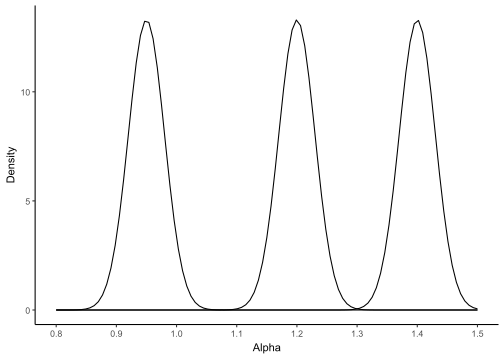
\[x_{8i} \sim \text{Beta}(\mu_{8i} \cdot \phi_8, \, (1 - \mu_{8i}) \cdot \phi_8))\]\[\text{logit}(\mu_{9i}) = \tau_{9j} + \alpha_9 + \beta_1 \cdot (x_{8i} - \bar{x}_8)\]\[x_{9i} \sim \text{Beta}(\mu_{9i} \cdot \phi_9,\ (1 - \mu_{9i}) \cdot \phi_9)\]\[\text{logit}(\mu_{10i}) = \tau_{10j} + \alpha_{10} + \beta_2 \cdot (x_{8i} - \bar{x}_8) + \beta_3 \cdot (x_{9i} - \bar{x}_9)\]\[y_{10i} \sim \text{Beta}(\mu_{10i} \cdot \phi_{10},\ (1 - \mu_{10i}) \cdot \phi_{10})\] Let’s try to write some reasonable priors for the \(\alpha\) and \(\tau\) parameters. Alpha represents the expected log-odds grade for the average student. In the previous chapters we assumed that the average student would finish with 80%, 77%, and 72% in year 8, 9, 10 respectively. Thus, we could set the following priors.
\[\alpha_8 \sim N(1.4, 0.03)\]\[\alpha_9 \sim N(1.2, 0.03)\]\[\alpha_{10} \sim N(0.95, 0.03)\] Now let’s pivot to focus on the \(\tau\) parameters which represent the teacher effects.We know some teacher’s are harsher than others but we can assume than the average teacher is a relatively grader. In other words, we assume that teacher bias is a random error of measurement instead of a systematic one. It’s entirely possible that teachers are systematically too generous in their grading because they want their students to succeed.
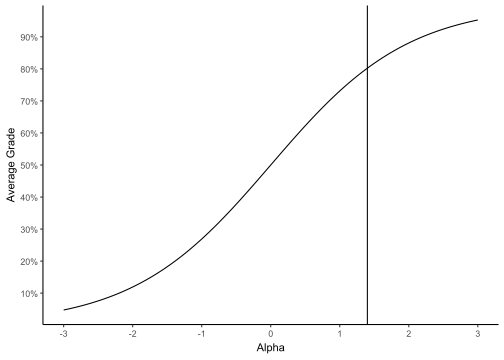
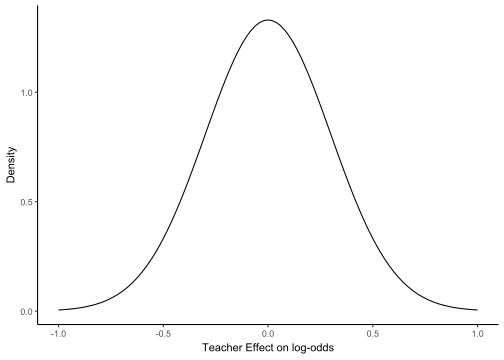
As seen in Figure 5.2 a one unit increase in log-odds represents roughly a 20% difference in student grades. We don’t expect teacher effects to be this strong so we might set the following prior.
    student        teacher_8             bias_8         teacher_9
 Min.   :  1.00   Length:250         Min.   :-0.3000   Length:250
 1st Qu.: 63.25   Class :character   1st Qu.:-0.3000   Class :character
 Median :125.50   Mode  :character   Median : 0.0000   Mode  :character
 Mean   :125.50                      Mean   : 0.0184
 3rd Qu.:187.75                      3rd Qu.: 0.2500
 Max.   :250.00                      Max.   : 0.2500
     bias_9        teacher_10           bias_10             mu8
 Min.   :-0.500   Length:250         Min.   :-0.3000   Min.   :0.7484
 1st Qu.:-0.500   Class :character   1st Qu.:-0.3000   1st Qu.:0.7484
 Median : 0.000   Mode  :character   Median : 0.2000   Median :0.8006
 Mean   :-0.162                      Mean   : 0.0808   Mean   :0.8007
 3rd Qu.: 0.000                      3rd Qu.: 0.2000   3rd Qu.:0.8375
 Max.   : 0.200                      Max.   : 0.4000   Max.   :0.8375
       y8              mu9               y9              mu10
 Min.   :0.4064   Min.   :0.2449   Min.   :0.2017   Min.   :0.1585
 1st Qu.:0.7011   1st Qu.:0.6279   1st Qu.:0.6307   1st Qu.:0.5927
 Median :0.8125   Median :0.7600   Median :0.7699   Median :0.7753
 Mean   :0.7912   Mean   :0.7193   Mean   :0.7292   Mean   :0.7057
 3rd Qu.:0.8915   3rd Qu.:0.8353   3rd Qu.:0.8697   3rd Qu.:0.8512
 Max.   :0.9933   Max.   :0.9184   Max.   :0.9899   Max.   :0.9323
      y10
 Min.   :0.1111
 1st Qu.:0.5641
 Median :0.7668
 Mean   :0.7096
 3rd Qu.:0.8868
 Max.   :1.0000
We see that our data is realistic and that teacher effects do indeed shift the distributions. Let’s focus our attention on the three teachers in year 9.
Code
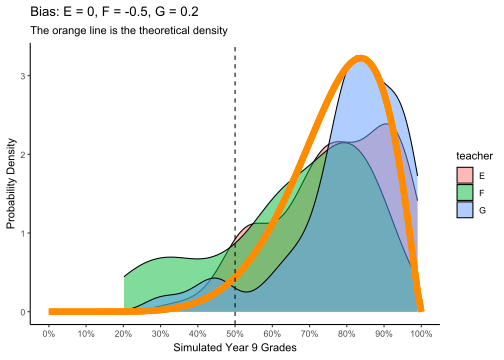
sim_grades_by_teacher |>filter(student_grade ==9) |>ggplot(aes(x = result, fill = teacher)) +geom_density(alpha =0.5) +stat_function(fun = dbeta,args =list(shape1 =0.77*10, shape2 = (1-0.77)*10),xlim =c(0,1),size =3, color ="darkorange" ) +geom_vline(xintercept =0.5, linetype ="dashed") +scale_x_continuous(breaks =seq(0, 1, 0.1),labels = scales::percent) +labs(title ="Bias: E = 0, F = -0.5, G = 0.2",,subtitle ="The orange line is the theoretical density",x ="Simulated Year 9 Grades",y ="Probability Density" )
We see that the green distribution is shifted to the left relative to the orange curve because of the negative bias of -0.5 on the log-odd scale. Conversely, the blue distribution is slightly shifted to the right while the red distribution roughly follows the theoretical distribution.
5.3 Consistent Teacher Effects
The previous simulation assumed that the teacher effects were independent between years. That is, a harsh grader in year 9 was no more likely to be a grader in year 10 than a easy grader. It seems reasonable to assume that some teachers are systematically harsher teachers than others across grades and that their bias may differ for different courses.
# A tibble: 250 × 10
   student teacher_8 teacher_9 teacher_10 zeta_8  zeta_9 zeta_10  tau_8   tau_9
     <int> <chr>     <chr>     <chr>       <dbl>   <dbl>   <dbl>  <dbl>   <dbl>
 1       1 D         F         H          0.382  -0.0489 -0.0240 0.421  -0.0834
 2       2 D         E         H          0.382   0.111  -0.0240 0.421   0.103
 3       3 D         F         H          0.382  -0.0489 -0.0240 0.421  -0.0834
 4       4 D         F         G          0.382  -0.0489  0.119  0.421  -0.0834
 5       5 D         F         H          0.382  -0.0489 -0.0240 0.421  -0.0834
 6       6 B         G         G          0.0107  0.119   0.119  0.0478  0.189
 7       7 D         F         F          0.382  -0.0489 -0.0489 0.421  -0.0834
 8       8 A         E         F          0.186   0.111  -0.0489 0.313   0.103
 9       9 D         F         H          0.382  -0.0489 -0.0240 0.421  -0.0834
10      10 C         E         G          0.232   0.111   0.119  0.216   0.103
# ℹ 240 more rows
# ℹ 1 more variable: tau_10 <dbl>
    student        teacher_8          teacher_9          teacher_10
 Min.   :  1.00   Length:250         Length:250         Length:250
 1st Qu.: 63.25   Class :character   Class :character   Class :character
 Median :125.50   Mode  :character   Mode  :character   Mode  :character
 Mean   :125.50
 3rd Qu.:187.75
 Max.   :250.00
     zeta_8            zeta_9            zeta_10             tau_8
 Min.   :0.01069   Min.   :-0.04886   Min.   :-0.04886   Min.   :0.04779
 1st Qu.:0.23195   1st Qu.:-0.04886   1st Qu.:-0.04886   1st Qu.:0.21566
 Median :0.23195   Median : 0.11129   Median :-0.02400   Median :0.31348
 Mean   :0.27591   Mean   : 0.04816   Mean   : 0.03618   Mean   :0.30405
 3rd Qu.:0.38175   3rd Qu.: 0.11129   3rd Qu.: 0.11913   3rd Qu.:0.42146
 Max.   :0.38175   Max.   : 0.11913   Max.   : 0.11913   Max.   :0.42146
     tau_9              tau_10             mu8               y8
 Min.   :-0.08335   Min.   :0.01322   Min.   :0.8081   Min.   :0.4241
 1st Qu.:-0.08335   1st Qu.:0.01322   1st Qu.:0.8328   1st Qu.:0.7625
 Median : 0.10329   Median :0.05332   Median :0.8460   Median :0.8640
 Mean   : 0.04510   Mean   :0.07351   Mean   :0.8440   Mean   :0.8346
 3rd Qu.: 0.10329   3rd Qu.:0.12270   3rd Qu.:0.8595   3rd Qu.:0.9323
 Max.   : 0.18935   Max.   :0.12270   Max.   :0.8595   Max.   :0.9927
      mu9               y9              mu10              y10
 Min.   :0.2838   Min.   :0.1072   Min.   :0.08653   Min.   :0.0379
 1st Qu.:0.7091   1st Qu.:0.6789   1st Qu.:0.63449   1st Qu.:0.5636
 Median :0.8019   Median :0.8044   Median :0.77314   Median :0.7685
 Mean   :0.7617   Mean   :0.7641   Mean   :0.71230   Mean   :0.7057
 3rd Qu.:0.8520   3rd Qu.:0.9004   3rd Qu.:0.83975   3rd Qu.:0.8688
 Max.   :0.8913   Max.   :0.9948   Max.   :0.89775   Max.   :0.9993
# Compile the Stan Modelteacher_mod <-cmdstan_model(stan_file ='stan_models/teacher_model.stan')# Fit the modelfit_teacher_mod <- teacher_mod$sample(dat = data_list,seed =2025 )# Save the Stan modelfit_teacher_mod$save_object(file ="stan_models/fit_teacher_mod.RDS")fit_teacher_mod$cmdstan_diagnose()rm("teacher_mod", "fit_teacher_mod")
Code
# Load the Stan modelfit_teacher_mod <-readRDS("stan_models/fit_teacher_mod.RDS")
Computed from 4000 by 250 log-likelihood matrix.

         Estimate   SE
elpd_loo    202.0 11.1
p_loo         4.9  0.5
looic      -404.0 22.1
------
MCSE of elpd_loo is 0.0.
MCSE and ESS estimates assume MCMC draws (r_eff in [0.8, 1.6]).

All Pareto k estimates are good (k < 0.7).
See help('pareto-k-diagnostic') for details.